If you’ve been researching treatment options for a disc problem, spinal stenosis, or persistent back pain, you’ve likely encountered the term spinal decompression. It appears across clinic websites, patient forums, and medical literature – sometimes used precisely and sometimes loosely. For anyone considering it as a treatment option, understanding exactly what non-surgical spinal decompression involves, how it produces its effects, and which presentations respond best to it is genuinely important.
This isn’t a procedure surrounded by mystery – it’s a well-understood mechanical intervention with a clear physiological rationale. And for the right patient with the right presentation, it represents one of the most effective non-invasive tools available in modern spinal care.
The Mechanical Problem That Spinal Decompression Solves
Most of the conditions that respond well to spinal decompression share a common underlying mechanism: excessive pressure within or around the spinal disc that is compressing adjacent nerve structures.
In a healthy disc, the nucleus pulposus – the gel-like interior – is under positive pressure that helps maintain the disc’s height and its ability to absorb and distribute load. When a disc is herniated, bulging, or degenerating, this pressure dynamic changes in ways that allow disc material to impinge on nerve roots or the spinal cord itself. The resulting nerve compression produces the pain, tingling, numbness, and weakness patterns that characterise most disc-related spinal conditions.
Spinal decompression works by reversing this pressure dynamic. By applying controlled, intermittent traction across the affected spinal segment, the technique creates a negative pressure environment within the disc – a gentle suction effect that encourages protruded material to retract toward the disc’s centre and draws in the fluid and nutrients the disc needs to recover.
What Actually Happens During a Treatment Session
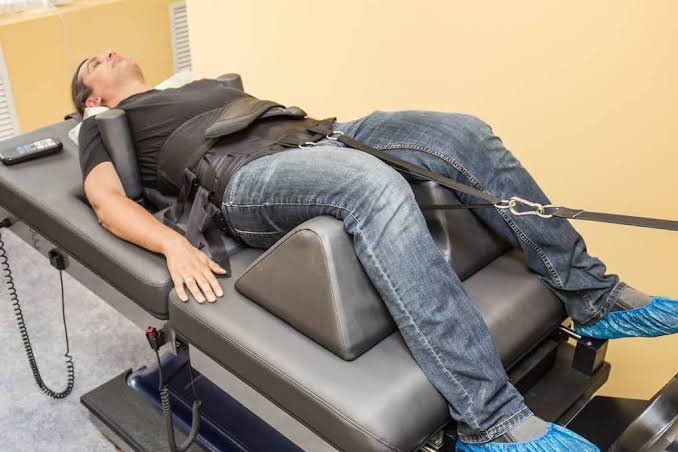
Non-surgical spinal decompression is performed on a specialised table that is divided into sections – typically one fixed and one mobile, controlled by a computer system. The patient lies on the table and is comfortably secured with harnesses appropriate for the spinal region being treated (lumbar or cervical).
The computer-controlled motor applies a carefully calculated distraction force that gently separates the target vertebral segments. Critically, the force cycles between a peak distraction level and a partial rest phase in a controlled rhythm. This cycling pattern is what produces the pumping effect on the disc – alternating between decompression (which creates the negative pressure and draws material inward) and partial relaxation (which allows fluid and nutrients to be drawn into the disc).
Sessions typically last between twenty and forty-five minutes. A full course of treatment generally involves multiple sessions over several weeks, with the frequency and total number tailored to the severity of the condition and the patient’s response.
The Physiological Effects That Drive Recovery
Several interconnected physiological processes occur during and between decompression sessions that cumulatively produce the therapeutic effect:
Disc retraction: The negative intradiscal pressure created during distraction can encourage herniated or bulging disc material to move back toward its central position, progressively reducing its mechanical pressure on the affected nerve root.
Disc rehydration: Spinal discs have no direct blood supply and rely on the mechanical pumping of movement and pressure changes to draw in the fluid and nutrients they need. Decompression therapy enhances this process, supporting the disc’s capacity for self-repair.
Nerve decompression and recovery: As pressure on the nerve root reduces session by session, the inflammatory response around the compressed nerve can begin to resolve. Nerve tissue, when given adequate space and improved circulation, has a meaningful capacity for recovery – particularly when compression has not been so prolonged that structural nerve damage has occurred.
Improved segmental mobility: The mobilisation of stiffened vertebral segments that accompanies decompression gradually improves the overall movement mechanics of the treated spinal region.
Which Conditions Respond Best to Spinal Decompression
Non-surgical spinal decompression is most effective for conditions where disc-related nerve compression is the primary mechanism:
- Lumbar disc herniation producing sciatica or lower back nerve pain
- Cervical disc herniation causing arm pain, hand tingling, or weakness
- Disc bulging at any level producing localised or radiating pain
- Lumbar or cervical spinal stenosis where disc and facet changes have reduced canal space
- Degenerative disc disease contributing to chronic back or neck pain
- Facet syndrome with secondary disc involvement
Conditions involving spinal instability, fractures, osteoporosis, or active infection are generally not suitable for decompression therapy. A thorough assessment before treatment begins is essential to confirm that the technique is both appropriate and safe for each individual patient.
What to Expect from a Full Course of Treatment
At ANSSI Wellness, Non-Surgical Spinal Decompression is the foundation of the centre’s Back Pain Treatment approach. Each patient’s programme is built from an individual assessment that identifies the precise spinal levels involved, the degree of disc disruption, and the presence of neurological signs that guide treatment parameters.
Most patients begin to notice a reduction in symptom severity within the first several sessions, though this varies depending on the chronicity and severity of the condition. The full benefit of a decompression course accumulates progressively – the structural changes in disc position and hydration build incrementally across multiple sessions.
Complementary physiotherapy and rehabilitation run alongside the decompression sessions to rebuild the muscular support that protects the recovering disc and to address the postural and movement patterns that contributed to the original problem.
Conclusion
Non-surgical spinal decompression is a precisely targeted, well-understood intervention for disc-related spinal conditions. It works with the body’s natural healing processes rather than against them, producing structural changes that address the root cause of nerve compression rather than simply managing its symptoms. For the right patient, it represents a genuine alternative to surgery – and for many, it is the treatment that finally delivers the lasting relief that other approaches have not.